
Our changing transportation world
By Gary Williams, Director of Transportation and Regulatory Affairs
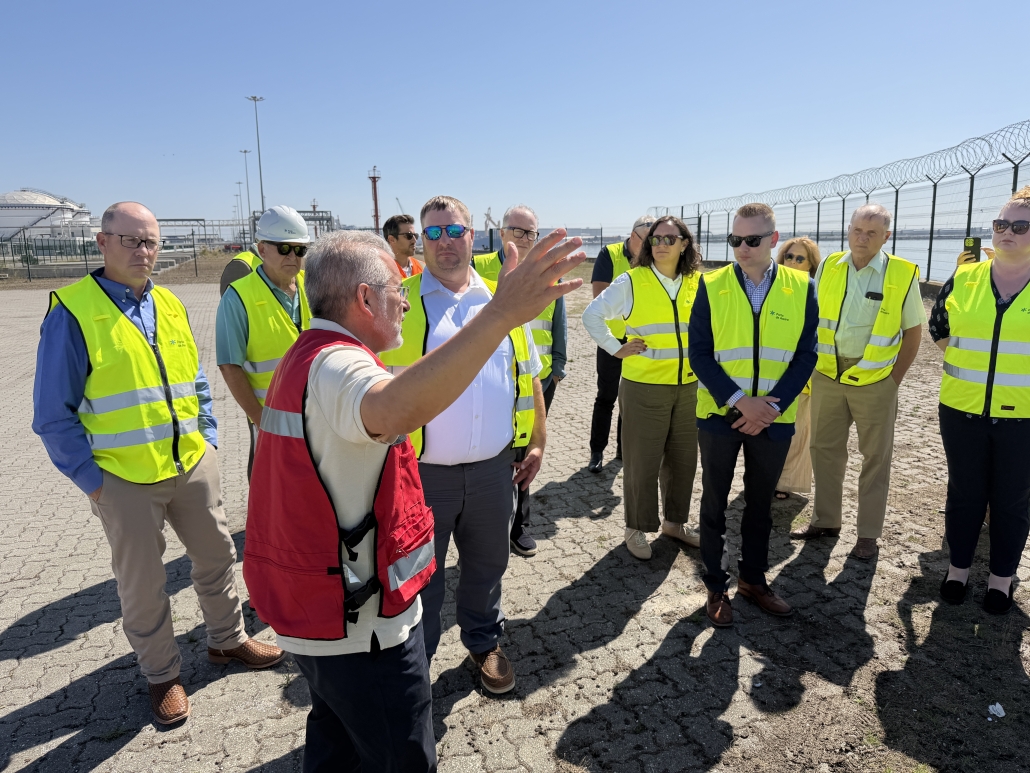
The overriding message from the most recent Great Lakes–St. Lawrence Seaway Trade Revitalization Mission was impossible to ignore: Transportation networks are changing quickly in response to bottlenecks, shifting supply-and-demand patterns, geopolitical risk, and geographic advantage.
Across Africa, Morocco, Portugal and southern Spain, ports and transportation agencies are investing heavily in the infrastructure needed to capture emerging trade. The common theme is clear: Ports are not waiting for demand to arrive. They are building capacity, improving rail connections, deepening channels, expanding terminals and positioning themselves for a very different global trade map.
Africa’s long-term demand potential
One of the most consequential changes in global trade is Africa’s population trajectory. A July 2024 projection from the United Nations Population Division anticipates that Africa’s population could increase by roughly 1 billion people, from approximately 1.5 billion today to 2.5 billion by 2050, representing about 28% of the world’s population.
For U.S. agricultural exporters, this points to a substantial long-term expansion in demand for food, feed, livestock, poultry, aquaculture, edible oils, protein and food-processing inputs. A larger and increasingly urban population will require more reliable supplies of grains, soybeans, soybean meal, vegetable oils, specialty food ingredients and animal-protein inputs.
Of course, this opportunity is not automatic. Future import demand will depend on income growth, agricultural productivity, trade policy, port and inland infrastructure, foreign-exchange availability and the competitiveness of U.S. suppliers relative to Brazil, Argentina, Black Sea suppliers, Europe and Asia.
Still, the projected addition of nearly 1 billion people makes Africa one of the world’s most important long-term demand-growth regions for agricultural trade. The transportation world is taking note.
Morocco’s growing gateway role
Morocco is rapidly positioning itself as a logistics gateway between Europe, Africa and the Americas.
Tanger Med began operations only in 2007–2008 and expanded with Tanger Med 2 in 2019. In December 2024, APM Terminals completed an additional 2 million-TEU expansion. Looking ahead, Morocco has announced approximately $2.8 billion in investment for 2026–2030, intended to increase Tanger Med’s capacity from 11.1 million TEU handled in 2025 to 15 million containers by 2030.
Tanger Med is fundamentally a transshipment port. Cargo is not intended to sit long; speed, connectivity and vessel transfers are the business model. More than 75% of its activity is targeted toward transshipment, and it is now by far the largest container port in Africa.
The port’s geographic position has become even more valuable amid conflict and uncertainty around the Suez Canal and Red Sea shipping routes. For carriers seeking an efficient western Mediterranean and Atlantic transshipment option outside the immediate conflict zone, Tanger Med is increasingly attractive.
Morocco is also developing the new Dakhla Atlantic Port near El Argoub, roughly 70 kilometers north of Dakhla city, in territory administered by Morocco in Western Sahara. Construction has advanced significantly, with project reporting in mid-2026 indicating that the overall project was approximately 62% complete and the marine access bridge about 85% complete. Moroccan officials have targeted commissioning in 2028.
With a planned draft of 23 meters, Dakhla Atlantic is designed to accommodate the world’s largest vessels. The port is also being positioned as a future gateway for the Sahel and nearby landlocked African countries, supported by regional cooperation and planned road, logistics, industrial and trade connections.
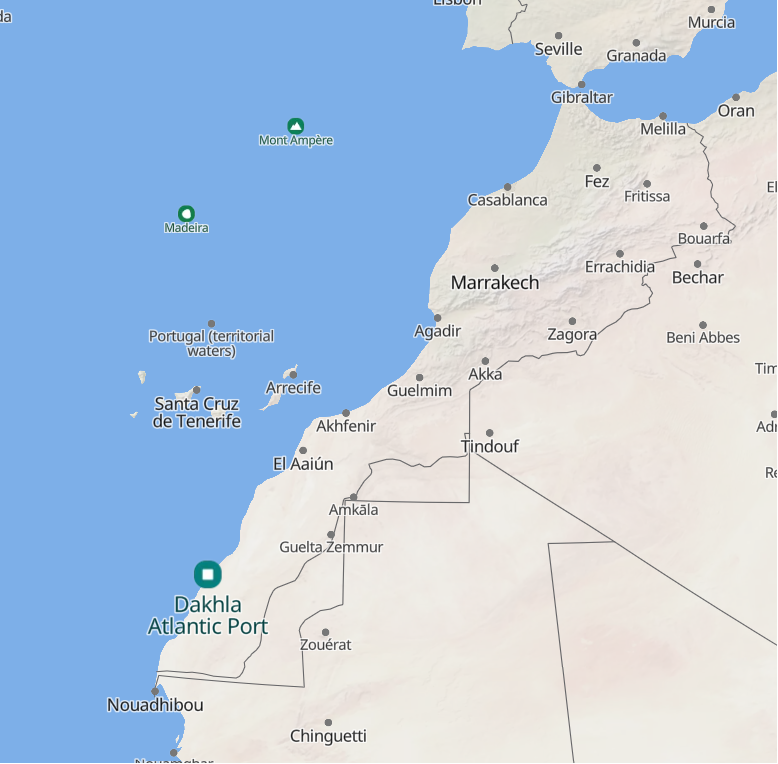
Map image by MapCarta.
Expanded opportunities in Portugal
The next stops on the trade mission included Lisbon, Aveiro, Porto and Leixões, Portugal. Here again, the delegation found substantial port capacity and major planned investments aimed at serving not only Portugal, but also Spain and inland European markets connected by rail.
At Aveiro, local officials highlighted Portugal’s new Porto–Lisbon high-speed passenger rail project, supported by the European Investment Bank. The estimated €3 billion project will build a new high-speed line between Porto and Lisbon, reducing the current roughly three-hour passenger trip to approximately one hour and 15 minutes.
The passenger-rail project also has freight implications. By shifting passenger trains to a new dedicated line, it can help free capacity on the conventional rail network for freight movements serving Spain and interior European markets. That additional rail capacity could strengthen Aveiro’s role as an initial discharge location for cargo headed into Iberia and beyond.
Aveiro is planning approximately €116.9 million in investment through 2030 for larger-vessel access, rail-connected logistics and industrial expansion, and port modernization. Its strategy includes improved navigability, a maritime-road-rail intermodal terminal at the port’s logistics and industrial zone, digital operating systems, shore power and energy-transition infrastructure.
Leixões, near Porto, is pursuing an equally significant modernization and expansion program. Its long-range plan includes €931 million in investment through 2035, including approximately €430 million for an expanded container terminal. The port’s objective is to increase annual cargo volumes from about 14.4 million tons to 20 million tons, while container throughput is targeted to reach 1 million TEU.
For both Aveiro and Leixões, the message is consistent: greater rail integration, deeper maritime access, modern terminals, and industrial logistics capacity are essential if Portugal is to capture more cargo moving between the Atlantic, Spain and the wider European Union.
Southern Spain’s strategic advantage
As the team divided into a smaller group to assess southern Spain as a possible future trade-mission destination, we were again struck by the scale of investment and growth planning at Algeciras and Málaga.
Both ports emphasize speed, efficiency and their geographic advantage at the entrance to the Mediterranean. They are positioning themselves as alternatives for cargo that may otherwise move through the congested northern European gateways of Rotterdam, Amsterdam and Antwerp.
Algeciras is already one of Europe’s leading container and transshipment ports, handling more than 100 million metric tons in 2025. The port has established a goal of approximately 120 million tons by 2030, supported by major public and private capital investments.
Near-term investment is projected at approximately €1.388 billion, combining public and private infrastructure spending and terminal investments. The program includes expanded container terminal capacity, improved rail access, port-road connections, new roll-on/roll-off and ferry infrastructure, shore power and broader modernization of port systems.
After the planned terminal investments, Algeciras expects container capacity to exceed 7.5 million TEU annually, with infrastructure reserved for as much as 9 million TEU by 2035. Its strategy is not only to protect its role as a major transshipment hub, but also to capture more import-export cargo moving between Iberia, Europe, Africa and the Americas.
Once again, geography matters. The Strait of Gibraltar remains one of the world’s most strategically important maritime locations, and Algeciras is using investments in terminals, rail, energy and landside logistics to convert that geographic advantage into sustained commercial growth.
A transportation system in motion
The takeaway from this United State Identity Preserved Alliance-led mission is that global transportation patterns are not static. Ports, railroads, logistics providers, shippers, and governments are responding to changing population centers, supply-chain disruptions, congestion, geopolitical risk, environmental requirements and competitive pressures.
Africa’s population growth is creating future demand. Morocco is expanding its role as a gateway between continents. Portugal is linking port development to new rail capacity and Iberian market access. Southern Spain is building on strategic geography to become an increasingly important alternative gateway for European cargo.
Over the next five years and well into the next quarter century, transportation routes are likely to continue shifting as end-use markets evolve and new efficiencies emerge. Shippers should recognize that transportation plans will be influenced by this changing world: a world where infrastructure investment often anticipates trade growth rather than merely reacts to it.


Leave a Reply
Want to join the discussion?Feel free to contribute!