Transportation Roundup: The truth behind the numbers

Two ocean common carriers have reached agreement with the Federal Maritime Commission (FMC) to resolve allegations of misconduct.

Ocean Network Express (ONE) resolved allegations of assessing detention charges when appointments were unavailable during allocated free time to return equipment by paying the $1.7 million civil penalty. ONE will also pay back the impacted shippers with refunds and waivers.

The FMC also reached an agreement with Wan Hai Lines, paying $950,000 in civil penalties for failing to observe and enforce just and reasonable practices regarding charges related to empty container returns. Wan Hai also refunded the detention charges to the shippers impacted.

Read more from the FMC.

Headlines in the shipping industry lately show extreme numbers and while the year-over-year declines are factual, this article from Freightwaves reminds us to read the fine print on those numbers.

The historically high 2022 statistics make this year’s numbers, like the Port of Long Beach’s 22% import drop year-on-year in April, or first-quarter profits from several carriers down 90% or more, look staggering. But U.S. imports this year are actually similar to 2018-2019 and imports this summer are estimated slightly above pre-pandemic levels, according to the Global Port Tracker by the National Retail Federation and Hackett Associates.

Over in the trucking industry, U.S. Reps. Rick Crawford (R-Ark.) and Henry Cuellar (D- Texas) introduced a bill to ease requirements for 18- to 20-year-old drivers interested in the Safe Driver Apprenticeship Pilot program. The program currently has fewer than 12 drivers enrolled when it was intended for up to 3,000 drivers. The American Trucking Associations attributed the low participation on unnecessary U.S. Department of Transportation (DOT) requirements that weren’t included in the Bipartisan Infrastructure Law.

The proposed bipartisan bill, called the DRIVE Safe Integrity Act, urges the DOT to provide detailed reports on the program status and corrective action to improve participation. The bill also directs DOT to review the safety data and regulations for a permanent apprenticeship program after the pilot program ends. Read more from the American Trucking Associations.

Class I railroad unions are calling out employers for misleading efforts for hiring more employees. In a filing to the Surface Transportation Board (STB), a representative of several rail unions said that the number of railroad employees is still far below the number needed to grow network capacity and provide exceptional rail service.

Class 1 railroad reports to the STB show the number of employees is the highest since May 2020, but the unions argue that these numbers don’t tell the whole story. The data is reported by department, not by craft, and the data doesn’t consider the rate of attrition. Read more about this data from Freightwaves.

Transportation Roundup: OSRA hits milestone

On May 1, the Ocean Shipping Reform Act’s Charge Complaint process surpassed $1 million in waived or refunded disputed charges to shippers and truckers. The milestone comes more than 10 months after the OSRA became law.

According to a press release issued by the Federal Maritime Commission (FMC), which administers the process, Charge Complaints provide a simplified and expedited process for shippers, consignees, truckers, and third parties to dispute charges which might have been wrongly assessed by a common carrier.

The Commission’s website has detailed information about the charge complaint procedure, including an instructional video on how to make a filing, and frequently asked questions.

The charge complaint process is one of several options available to parties seeking relief at the Commission. Disputes can also be addressed through the small claims or formal complaints processes, or by making use of dispute resolution services. Parties wanting to allege misconduct can also share information with the Commission that will be reviewed for potential investigatory action.

The total amount of fees waived or refunded through the charge complaint process does not include penalties or settlements realized through Commission enforcement activities.

More information on filing shipping complaints is available here.

In other transportation news:

  • After a few years of huge profits for container shippers, Drewry Maritime Research expects the industry to report a $10 billion loss in 2024. Carrier profits have been falling since the second half of 2022 and will continue with a capacity growth of 25% and new contracts signed at lower rates this year. Carriers profited $296 billion before tax in 2022 and are expected to profit $16.5 billion in 2023. Learn more about the Drewry report here.
  • Although down 18% from April 2022, U.S. ports imported more than 2 million twenty-foot equivalent units (TEUs) last month. This is up 9% from March and consistent with pre-pandemic volumes. Ports seeing the largest level of surges month over month were the Port of New York/New Jersey with a 19% increase and Savannah, Georgia with a 15% increase. More April import data is available here. The trends are expected to continue through at least peak shipping season, with high inflation somewhat compromising consumer spending, according to the latest Global Port Tracker.
  • In the rail industry, the Surface Transportation Board extended reporting of service data metrics to three Class I railroads: Union Pacific, BNSF and Norfolk Southern. CSX met nearly all one-year service targets and will no longer need to report the biweekly progress reports. All railroads will still be required to submit weekly performance and monthly employment data through 2023. Freightwaves has more on the STB updates here.

Transportation Roundup: Labor negotiations continue to intensify

Operations at the Ports of Los Angeles and Long Beach grinded to a halt last week due to a manpower shortage possibly related to the ongoing labor dispute between the International Longshore and Warehouse Union (ILWU) and the Pacific Maritime Association, who have been contract negotiations for more than 11 months.

Trucks attempting to deliver into the port complexes were turned around, according to reports.

On Monday the ILWU Local 13 delayed work by slowing the dispatch of workers, according to the Journal of Commerce, resulting in delays but not a full stoppage of work.

Read more from the Journal of Commerce.

Earnings slow for container lines

First-quarter earnings from container lines are showing a large decrease from the 2022 fourth quarter, although their income is still well above pre-COVID earnings.

Cosco earned $1 billion in the first quarter, down 75% year on year but six times higher than their 2019 quarter one earnings. Cosco subsidiary OOCL reported a drop of 56% year over year and 31% less than quarter four. Read more about quarter one earnings here.

CSCMP to hold logistics panel

The Council of Supply Chain Management Professionals (CSCMP) Twin Cities Roundtable will hold an International Logistics Panel on April 19 at Lee & Associates in St. Louis Park, Minnesota. The event will be moderated by Steve Balaski, director, business development for The Northwest Seaport Alliance and include panelists from J.B. Hunt, Yardbird/Best Buy, The Scoular Company and BNSF Railway. Click here for more information.

Other items of note:

Inflation’s inventory gluts are here to stay and will hit the bottom line in weaker economy: CNBC Supply Chain Survey

U.S. imports bounce back in March despite dwindling China cargo

Transportation Roundup: FMC ruling and trucking woes

The Federal Maritime Commission (FMC) released a final rule last week amending the Rules of Practice and Procedure governing the compromise, assessment, mitigation, settlement and collection of civil penalties. The changes will require ocean carriers to refund importers and exporters for overcharges and possibly for other violations. The rule will go into effect April 19. Read the entire rule in the federal register here. FMC Commissioner Max Vekich was at SSGA’s Transportation Go! in March to discuss OSRA and other FMC priorities. Read more from his presentation and the event here.

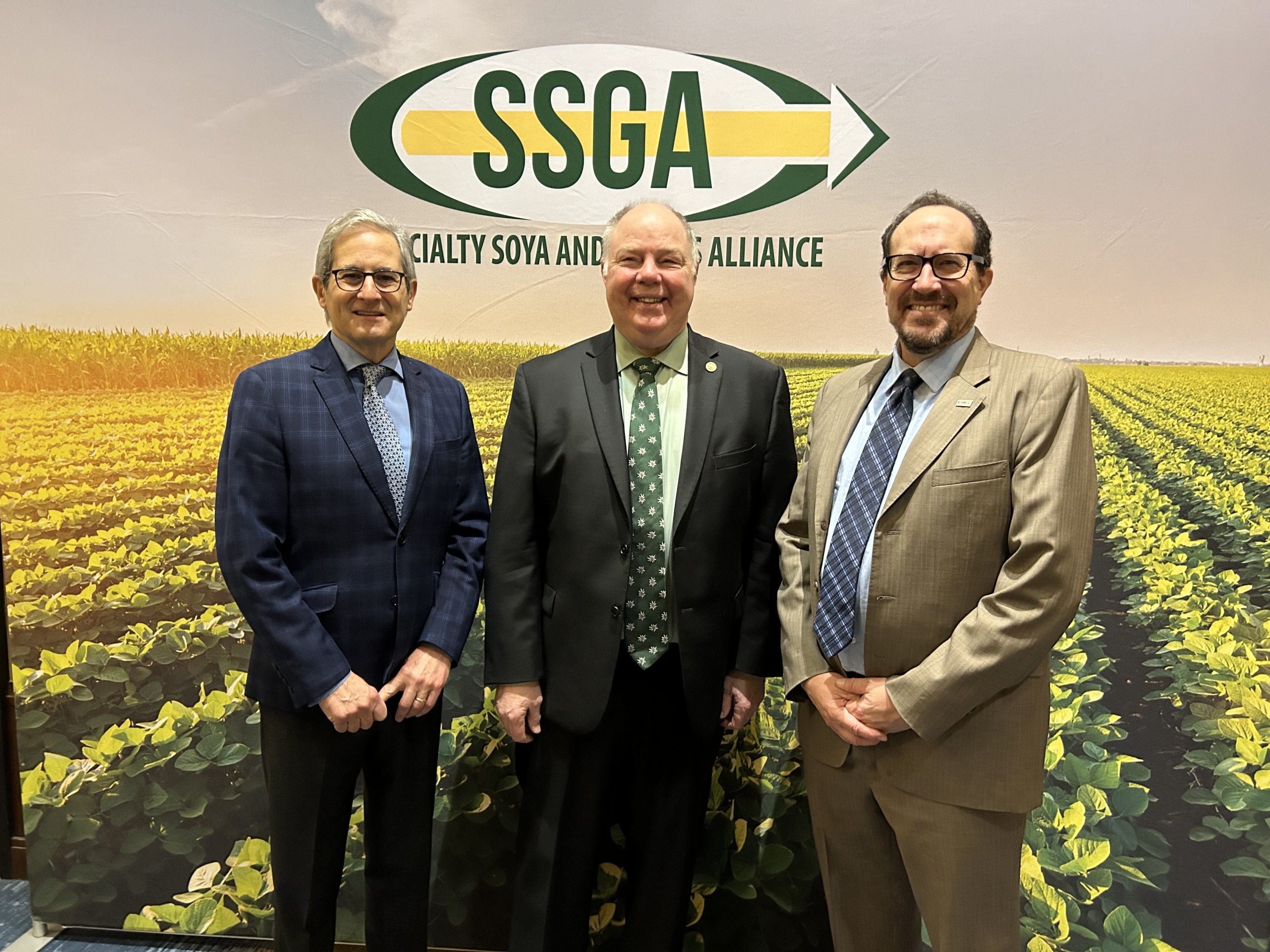
Peter Friedmann, Agriculture Transportation Coalition, Max Vekich, Federal Maritime Commission and Eric Wenberg, SSGA

At Transportation Go!, Alex Leslie from the American Transportation Research Institute discussed some of the challenges in the trucking industry, including lack of truck parking and lack of drivers. At a hearing last week, U.S. Transportation Secretary Pete Buttigieg told U.S. senators that just 22 carriers and four apprentices are approved for the Federal Motor Carrier Safety Administration’s pilot program for 18–20-year-old drivers to operate commercial motor vehicles in interstate commerce. Buttigieg reported ways the department is trying to garner interest in this program, including a video campaign and social media to reach 2023 graduates. The three-year pilot program, which started last summer, could accommodate up to 1,000 carriers and 3,000 apprentices.

Imports at Ports of Long Beach and Los Angeles were their lowest since March 2020. Total imports were down to 487,846 twenty-foot equivalent units (TEUs) last month, dropping 43% from February 2022, and down 33% from January. The decrease wasn’t a surprise, as the ports continue to deal with high U.S. inventory, longshore labor negotiations and factories closed longer than expected for the Lunar New Year holiday. Read more from Freightwaves here.

The ongoing labor negotiations at the West Coast ports are stalled and unionized dockworkers are being blamed for slower cargo handling. The Pacific Maritime Association says workers are stopping work each day for mealtimes, rather than staggering lunch breaks and keeping operations going. The Agriculture Transportation Coalition (AgTC) was among the 238 U.S. shippers and transportation groups that signed a letter encouraging Biden administration intervention in labor talks so that a new agreement can finally be reached.

Other articles of note:

St. Lawrence Seaway begins navigation season

Not all recent import share loss on West Coast is permanent: analyst

More women become truckers as the industry tries to overcome a shortage of drivers

Transportation Go! connects supply chain through collaboration, innovative thinking

A common theme occurred at the 2023 Transportation Go! conference: Ag logistics and transportation are complex and ever-evolving, and finding solutions to the problems facing the industry require strong relationships, collaboration and out-of-the-box thinking.

Led by the Specialty Soya and Grains Alliance (SSGA), more than 120 of the sharpest minds in the logistics and transportation industry descended on Omaha, Nebraska, on March 15-16 to work through some of those issues facing the movement of agriculture out of the Upper Midwest.

“When you have the type of influencers that you had at this conference, such as Federal Maritime Commission (FMC) Commissioner Max Vekich, this opportunity to let them know what is happening in the real world of logistics or exporting agricultural goods from the U.S. is so important,” said Darwin Rader of Zeeland Farm Services, SSGA vice chair and former chair of our competitive shipping action team. “It can’t be overstated as far as how influential all this information can be.”

Vekich addressed the crowd on Day 2 of Transportation Go! Of note, he discussed last summer’s passage of the Ocean Shipping Reform Act (OSRA) – a bill and now-law strongly supported by SSGA – and changes within the FMC, including the charge-complaint mechanism, which he encouraged attendees to file if they feel action is needed.

“We want to make it so we’re a real regulatory agency,” said Vekich, a former longshoreman and Washington state legislator. “We’re going to stick up for the little guy. We’re not going to stand on the sideline; we’re going to get into the game and issue yellow cards, red cards, whatever it takes. … As shippers, you deserve a fair shot.”

While OSRA already has had a positive impact on U.S. exporters, the FMC is currently in the rulemaking process for enforcement of OSRA policy.

Attendees heard a wide range of presentations throughout the two-day conference, including current economic and supply chain trends and updates on trucking, rail and ocean shipping.

SSGA Executive Director Eric Wenberg highlighted the importance of the conference, and how it sparks action for attendees afterward.

“The transportation system isn’t really a system,” Wenberg said. “So we have to actively ask these transportation and logistics professionals to work together. Transportation is not seamless. As we’ve heard at this conference, there are obstacles in every transaction, sometimes insurmountable, but that there is relief on the way with the Federal Maritime Commission’s upcoming demurrage rule, which is going to provide relief we’ve sought for a long time.”

Other highlights:

David Briggs of Scoular addressed attendees about economics and the supply chain. He gave an update on the ports of Los Angeles and Long Beach, stating that they have recovered from the 2021 backlog, to having no ships in the queue as of March 2023.

Briggs highlighted two factors for the audience: Consumer spending during the pandemic and after has shifted, impacting how ocean carriers move freight; the West Coast ports are important to the global economy.

“If there is a problem with labor on the West Coast, it’ll affect everyone in the world,” he said.

Luisa Fernandez-Willey of the Association of American Railroads discussed the challenges for the rail system in the U.S., noting that industrial products drive manufacturing, and when there is a decline in industrial products, ultimately there is a decline in manufacturing, which impacts the rail system.

“Now that the economy has recovered, the demand for gasoline and petroleum products has increased,” she said.

She too pointed to consumer behavior, which drives intermodal shipping. Fernandez-Willey said during the pandemic, people bought items of comfort, which shifted the types of production of goods that were being shipped.

“There’s a very strong relationship between the economy and goods,” she said. “When the economy is doing well, rail is strong.”

While carloads of grain are down 9.7% from last year, she said, those are expected to rise by year’s end.

Brenda Snyder of HRG Search talked to attendees about recruiting, training and retaining shipping and logistics employees, which she said are some of the most sought after in the industry. Snyder said that by the time potential employees reach the university level, it is often too late to attract them to the industry.

“How do we get people at these kinds of events?” she said in reference to Transportation Go! “My guess is you all have kids, grandkids, nieces and nephews. Bring them with. Maybe they’d have an interest in this. You’re talking trains, planes, ships, trucks. Think about the coolness about what you have to do to get stuff all over the place. You have the cool stuff.”

Agricultural logistics, Snyder said, are mission-driven and involve not only solving big, mammoth, complex problems, but also feeding humans. “If you can’t market talent out of that, get a new marketing agency.”

John Wolfe of the Northwest Seaport Alliance reported that, with declining demand and reduced costs in imports, along with elevated inventories, that carriers are refocusing on exports. “Balanced trade is important,” he said, “so we’re working on solutions to help exporters get access to equipment.”

Partnerships are key, and the Northwest Seaport Alliance works with USDA and inland railyards to help containers reach the middle of America.

Wolfe also gave an update about the expansion happening in the ports of Seattle and Tacoma, Wash. Wolfe dispelled the narrative that the West Coast doesn’t have room for growth. He pointed to the expansion of 20-foot equivalent (TEU) container capacity, and the increase in port depth to 57 feet of water in the ports.

Shane Kinne of Coalition to Protect the Missouri River discussed the untapped potential of the Missouri River in moving product down to the Gulf of Mexico via the Mississippi River. More than 5.5 million tons of cargo move on the Missouri, and $278 million in infrastructure funds are earmarked for development on the United States’ longest river.

“It’s been an often-overlooked waterway over several decades,” Kinne said. “But we’re starting to see opportunities pay off.”

Peter Hirthe of the Great Lakes St. Lawrence Seaway Development Corporation noted that, as a trade lane, the Great Lakes and St. Lawrence Seaway is underutilized, only running about 50% capacity. Considering the region surrounding that area is the third-largest economy in the world, “there’s room to grow.”

“Canada uses it more but doesn’t have the PNW (U.S. Pacific-Northwest ports) or the river system,” he said. “But we can improve the ratio of U.S. exports.”

U.S. grain exports on the system were up 4.3% last year, and there have been several developments, with more on the way, including new or expanded infrastructure and facility developments at Duluth-Superior (Minn.-Wis.), Milwaukee (Wis.), Monroe (Mich.) and Oswego (N.Y.), as well as upcoming opportunities at Cleveland (Ohio), Burns Harbor (Ind.) and Green Bay (Wis.).

Alex Leslie of the American Transportation Research Institute discussed the challenges facing the trucking industry, including the aging driver demographic. Most are in the 45- to 64-year-old range. “This is a challenge for a couple reasons,” he said. “One, we have retiring drivers and we need to fill those gaps. Two, we need young people to learn and grow in this industry.”

Wage increases have helped, but lifestyle, including work-life balance remains an issue.

Availability of truck parking is also a top concern, he said.

Elaine Trevino of the U.S. Department of Transportation updated on the Supply Chain Task Force and discussed DOT initiatives for tracking and tracing, including the Ocean Shipping Container Availability Report (OSCAR) and a voluntary forecasting tool called Freight Logistics Optimization Works (FLOW).

“We see a need for improved transparency/accountability across all supply chains,” she said. “In the mid-term, we seek to improve and institutionalize data sharing. This industry is very opaque and lacks data.”

Competing and succeeding in the international marketplace, she said, requires being prepared to deal with uncertainty and knowing potential risks and opportunities.

Maria Bodnar of Ocean Network Express (ONE), discussed modernization and improvement to the shipping line, including new vessels, green initiatives and energy efficiencies, along with acquisition of terminals at various ports, putting ONE in control of some entire supply chains.

“We’re focused on smooth operations within the supply chain,” she said. “Communication is critical. We want to recover ocean shipping integrity. … We can be a good partner of the ag community.”

Brittany Batz of Cobblefield LLC served as Transportation Go’s moderator. She is an independent consultant focused on facilitating digitization and process improvement in the agriculture industry. Her company helps others drive operational efficiencies and enhance productivity through the implementation of digital solutions.

Transportation Go! was sponsored at the Show level by the Nebraska Department of Agriculture, along with the state’s corn, soybean, wheat and ethanol boards.

Platinum sponsors included the Minnesota Soybean Research & Promotion Council, South Dakota Soybean Checkoff, Illinois Soybean Association, North Dakota Soybean Council, Wisconsin Soybean Marketing Board, North Dakota Corn Council, Great Lakes St. Lawrence Seaway Development Corporation and Norseman Protective Solutions.

Gold sponsors included the Ohio Soybean Council and Scoular. Other sponsors included Buffers USA, Hang Tung Resources and Ray-Mont Logistics.

Transportation Roundup: News from TPM23 and more

Many people in the container shipping and logistics industry are attending the TPM23 conference this week in Long Beach, Calif. News from the event can be found on the Journal of Commerce website, but here are some leading stories in the shipping industry.

Container shipping analysts warned of upcoming blank sailings on the trans-Pacific this spring to prevent a further decline of east-bound spot rates. These blank sailings will not correct overcapacity, though, with capacity set to expand 9 percent in both 2023 and 2024. Although container rates are already back down to early 2020 rates, east-bound container spot rates will continue to fall further if containers lines don’t significantly blank their capacity. Read more here.

Hapag-Lloyd is the latest shipping line to adopt clean energy, signing an agreement with Shell to supply liquefied natural gas (LNG) for their large dual-fuel container vessels. LNG will enable Hapag-Lloyd to reduce the CO2 intensity of its vessels by up to 23%. Learn more about the agreement.

Following the Norfolk Southern train derailment in Ohio, U.S. Transportation Secretary Pete Buttiegieg called for action to improve freight railroad safety. Now the industry awaits a decision from the Federal Railroad Administration regarding a provision in a rule that went into effect in April 2020 about contractors and its employees. Before its inception, and still today, some unions believe the provision is not applicable, and therefore unreasonable, to Class I freight railroads. Unions are asking for clarification on this provision, or they believe the industry could be taking a step backward. Read more from Freightwaves.

Other news worth a read …

Nine ocean carriers commit to 100% electronic bill of lading by 2023, a move that is expected to save stakeholders billions of dollars. Read more in Supply Chain Dive.

Container trade’s next turn: Price wars, cheap contracts, new ships. … Via Freightwaves

Container shipping costs plunge as consumer spending declines … Via Financial Times

SSGA, AgTC to team up for ag transport events

SSGA Executive Director Eric Wenberg and AgTC Executive Director Peter Friedmann.

SSGA Executive Director Eric Wenberg and AgTC Executive Director Peter Friedmann.

The Specialty Soya and Grains Alliance has long had a great relationship with the Agriculture Transportation Coalition, known as AgTC. So we’re thrilled that AgTC plans to hold one of its workshops on the heels of Transportation Go!

Transportation Go! will take place March 15-16 at the Hilton Omaha in Omaha, Nebraska, and AgTC’s Ag Shipper Workshop at the same location following a joint lunch between the two events.

“Transportation Go! is an interactive conference that addresses the myriad challenges and opportunities ag shippers are facing,” said Eric Wenberg, SSGA executive director. “We appreciate that AgTC recognizes our agenda and wants to build upon that with its workshop. These are two events that will actually make a difference in the industry.”

Register for Transportation Go! at this link. Note that the hotel block is available through Feb. 21. Also, please note that AgTC’s workshop is a separate event, and registration for that can be found at this link.

Through an interactive agenda with high-profile speakers and unique networking opportunities, Transportation Go! promotes in-depth discussions about the global supply chain and how it affects the vital movement of agricultural products from the United States, notably the Upper Midwest. This year’s agenda includes Commissioner Max Vekich of the Federal Maritime Commission, Elaine Trevino of the U.S. Department of Transportation, David Briggs of Scoular Global Shipping and more.

During the AgTC workshop, attendees will discuss pressing challenges for exporters and importers in an informal and off-the-record way. Invited guests will include an ocean carrier and trucking executive.

“The Agriculture Transportation Coalition looks forward to partnering with the SSGA to provide a unique transportation forum,” said Peter Friedmann, AgTC’s executive director. “We will bring our AgTC-USDA Ag Shipper Workshop format, offering all Midwest agriculture the chance to dialogue face-to-face with top ocean carrier, trucking, rail and port gateway authorities who will come to Omaha. These transportation providers and ag exporters (and importers) can speak openly, benefiting by our no-press, off-the-record rules. Ag transport is adopting quickly to changing markets and needs — exporters of soybeans, grains, protein, dairy, corn and any other ag, will get insight into what the short term and long-term future holds, new and needed transport options, and decisions by Congress and Federal Maritime Commission that impact your transport options now.”

Transportation Roundup: Rail agreements and labor negotiations

The Federal Maritime Commission is working through more than 200 complaints against ocean carriers with rising demurrage and detention fees a top complaint. This comes even as congestion at ports eases and rates drop. In an interview with Supply Chain Dive, Commissioner Carl Bentzel said the FMC is prioritizing demurrage and detention fees as well as intermodal chassis refusals.

Last week, CSX railroad reached agreements with unions Brotherhood of Maintenance of Way – Employes Division (BMWED) and the Brotherhood of Railway Carmen (BRC) over sick leave, providing four paid sick days each year plus three paid personal days for sick time. Now unions are asking other Class I railroads to follow suit. Read more about the agreement here.

A rail union, Transportation Trades Department (TDD), AFL-CIO, is asking the Federal Railroad Administration to provide more oversight of railroads safety operations. This comes after a Norfolk Southern train derailed in Ohio on Feb. 3. TDD believes all Class I railroads should adopt the confidential close call reporting system, so that all employees can anonymously report safety concerns. While none of the seven major U.S. freight railroads currently uses the program, some have internal systems that perform similar functions. Read more about the opinion.

Dockworkers and marine terminal employees from the West Coast agreed to set aside Seattle’s Terminal 5 issue and resume labor negotiations.

Without a resolution, the impasse over the dockworkers’ contract could result in irreversible West Coast port losses, Agriculture Transportation Coalition (AgTC) Executive Director Peter Friedmann said recently. Read about that and more of Friedmann’s remarks to the Propeller Club of Northern California via the American Journal of Transportation here.

Transportation Go! agenda nearly finalized

Transportation Go!, the premier conference for soybean, grain and other agricultural transportation issues in the Midwest, is set to take place March 15-16, 2023, in Omaha, Nebraska, at the Hilton Omaha. Registration for this second-annual event is now open at transportationgo.com.

Our agenda is nearly finalized with Max Vekich, Federal Maritime Commission; Luisa Fernandez-Willey, Association of American Railroads; Elaine Trevino, U.S. Department of Transportation and more confirmed.

SSGA is also proud to be hosting local college students at the conference. Students from Bellevue University in the Supply Chain, Transportation and Logistics Management major are eager to attend and learn more at the conference, with Hang Tung Resources sponsoring the students’ registration fees. Fittingly, Jared Spader, Managing Director for Kincannon & Reed, will speak about developing talent in ag logistics during the dinner on March 15.

Learn more about our agenda and register at www.transportationgo.com.

Transportation Roundup: Spot rates fall; FMC seeks additional comments

Spot rates for container shippers are falling back to pre-pandemic levels in multiple areas. The Journal of Commerce reported that spot rates for Asia to North Europe fell to similar levels seen in January 2020, due to high inventory and inflation.

Meanwhile, the premium for East Coast shipments has been exhausted, as the spread between ocean spot rates to the East and West coasts has narrowed to pre-pandemic levels. The Drewry World Container Freight Index reports a spread of $1,169 between Shanghai-New York and Shanghai-Los Angeles spot rates on Jan. 26, down from $3,995 in late September.

A resurgence in COVID-19 cases in China after Lunar New Year celebrations might sound scary for the supply chain, but CNBC reports that this wave shouldn’t deteriorate operating conditions as badly this time. With up to 80% of the Chinese population already previously infected with Covid, the chances are slim for another major outbreak, said one Chinese government scientist.

The Federal Maritime Commission received almost 30 comments in response to its Notice of Proposed Rulemaking (NPRM) on Unreasonable Refusal to Deal or Negotiate issues last fall but will now seek additional comments regarding the proposed Respect to Vessel Space Accommodations rule. The original comments raised many good questions that the FMC says, “demand appropriate time and further opportunity for comment to be given thorough consideration.” Learn more on the supplemental notice here.

Readers are encouraged to bring forth their ideas and questions to Transportation Go! March 15-16 in Omaha where FMC Commissioner Max Vekich will attend and be on hand for a private meeting with SSGA members. Learn more and register for the event at www.transportationgo.com.

Shipping containers with agricultural goods aren’t transported on airplanes, but nonetheless, the Boeing 747 is making history as the last ever of the aircraft was delivered to Atlas Air on Tuesday. There are both passenger and freight versions of the aircraft, which began production in 1967 and made air travel accessible to the average person. Learn more about the end of the Boeing 747 era here.