
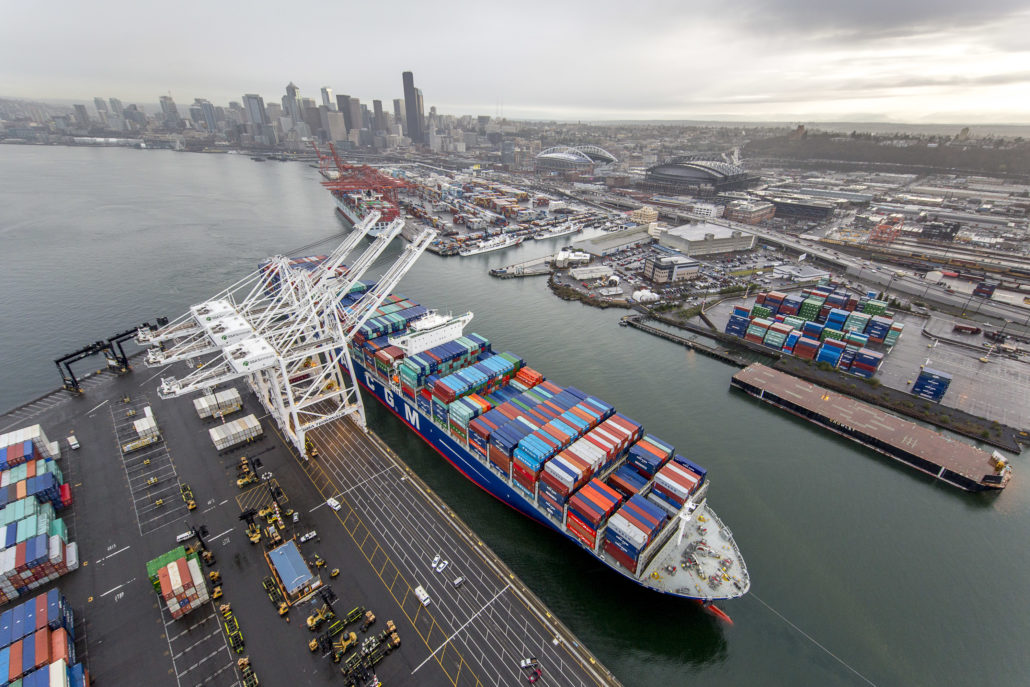
Thoughts and what I heard from Northwest Seaport Alliance Peak Planning Meeting
By Gary Williams, Director of Transportation and Regulatory Affairs
I’ve compiled some thoughts after listening to analysts from the Journal of Commerce and other industry stakeholders at the Northwest Seaport Alliance Peak Planning Meeting. Market signals show a less optimistic scenario for exporters ahead of export peak season. S&P recently revised its global growth projection downward from 2.6% to 2.1%, signaling a more cautious outlook for trade demand in the months ahead. While upcoming May and June data may not immediately reflect this slowdown due to comparison with a period that was weak the previous year, so appears more optimistic than it perhaps should.
Trade flows are shifting in notable ways. Chinese exports to the U.S. have declined by approximately 5%, yet this contraction is offset by remarkably strong export volumes to the rest of the world. Some Chinese ports are operating at nearly 90% capacity utilization. This divergence is widening the Chinese export/import imbalance and reshaping global trade lanes. At the same time, container spot rates have increased significantly over the past four weeks, rising 9-11% year-over-year, indicating tightening conditions despite broader economic concerns.
Fuel costs are emerging as a major pressure point. Bunker prices have doubled, and the financial impact is expected to intensify in July when bunker adjustment factors (BAFs) are formally updated. In the interim, carriers are implementing emergency surcharges to bridge the gap. Compounding this, additional compliance costs tied to fuel regulations, particularly ensuring vessels are operating with appropriate low-sulfur fuels, are adding to operational expenses that will ultimately be passed along to shippers.
Carriers are also taking more discipline in capacity management, driven by financials. Service suspensions and an increase in blank sailings are expected as lines shift vessel allocations away from underperforming routes. Despite continued overcapacity in the market, carriers are less willing to operate at a loss, supported by stronger balance sheets following the highly profitable pandemic-era years. Industry consolidation has further reinforced this discipline, with roughly 10 major carriers now dominating the market compared to about 20 in the past.
Looking ahead, capacity dynamics remain complex. Approximately 35% of the current global fleet is scheduled to come online within the next two years. However, much of this newbuild capacity consists of smaller vessels intended to replace aging ships and serve regional and secondary port markets, rather than dramatically expanding overall capacity. Meanwhile, scrapping rates have not accelerated as expected, in part due to ongoing equipment constraints.
Port congestion is also re-emerging as a concern in key regions. Congestion at some ports meanwhile, continues to add pressure to an already strained system. On the inland side, rising diesel costs are pushing drayage rates higher, while tighter trucking capacity, driven in part by a reduction in foreign CDL drivers, is nudging trucking rates upward. This is contributing to a modest shift toward rail, where feasible.
Although liquefied natural gas (LNG)-powered vessels are somewhat insulated from fuel price volatility, the majority of the global fleet continues to rely on low-sulfur diesel with scrubber systems to meet emissions requirements, leaving most operators exposed to rising fuel costs.
As the industry approaches peak season, the outlook is defined by a combination of cautious demand expectations, disciplined capacity management based on financial impacts, and escalating supply chain operating costs being passed along. The result is a market environment where volatility is likely to persist, and stakeholders across the supply chain will need to remain agile in response to significantly evolving conditions.
Container shipping sector likely will see some significant changes and increased complexities in getting equipment, stability in bookings/sailings/ERDs and rate impacts.


Leave a Reply
Want to join the discussion?Feel free to contribute!